📖 Software Engineer: From Programmer to Real Engineer
📖 Software Engineer: From Programmer to Real Engineer 🔥
🗝️ Introduction
Many people believe that once someone learns a programming language and writes code, they automatically become a Software Engineer.
But reality is deeper than that.
Writing code is only one part of the journey.
A real Software Engineer is someone who can build systems that:
✔ Work correctly
✔ Scale under pressure
✔ Stay secure
✔ Remain maintainable for years
✔ Solve real business problems
📌 Programming is the beginning... engineering is the higher level.
🎯 Core Idea
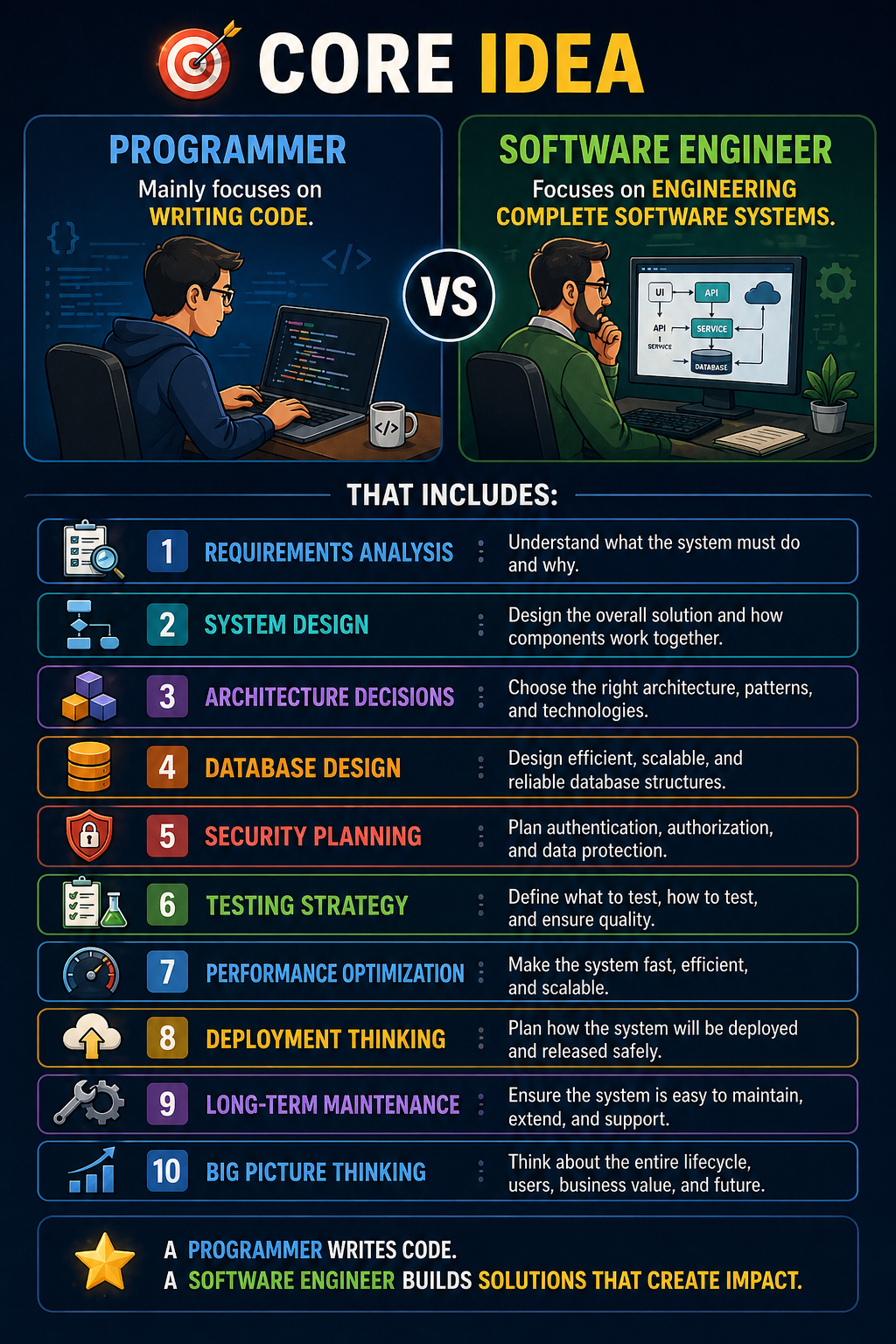
A Programmer mainly focuses on writing code.
A Software Engineer focuses on engineering complete software systems.
That includes:
🔹 Requirements analysis
🔹 System design
🔹 Architecture decisions
🔹 Database design
🔹 Security planning
🔹 Testing strategy
🔹 Performance optimization
🔹 Deployment thinking
🔹 Long-term maintenance
🎯 Key Point (VERY IMPORTANT)
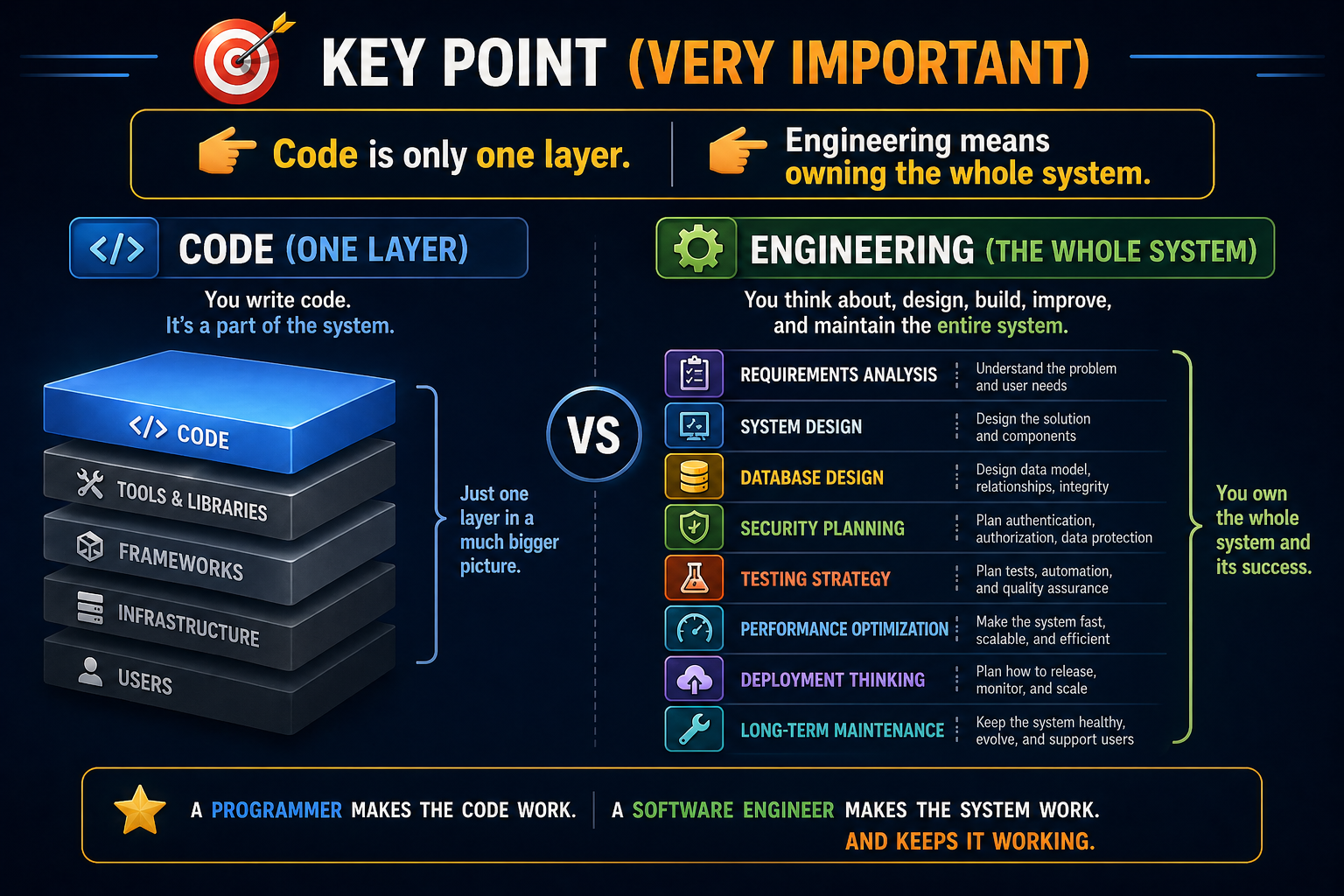
👉 Code is only one layer.
👉 Engineering means owning the whole system.
🧠 Mental Model
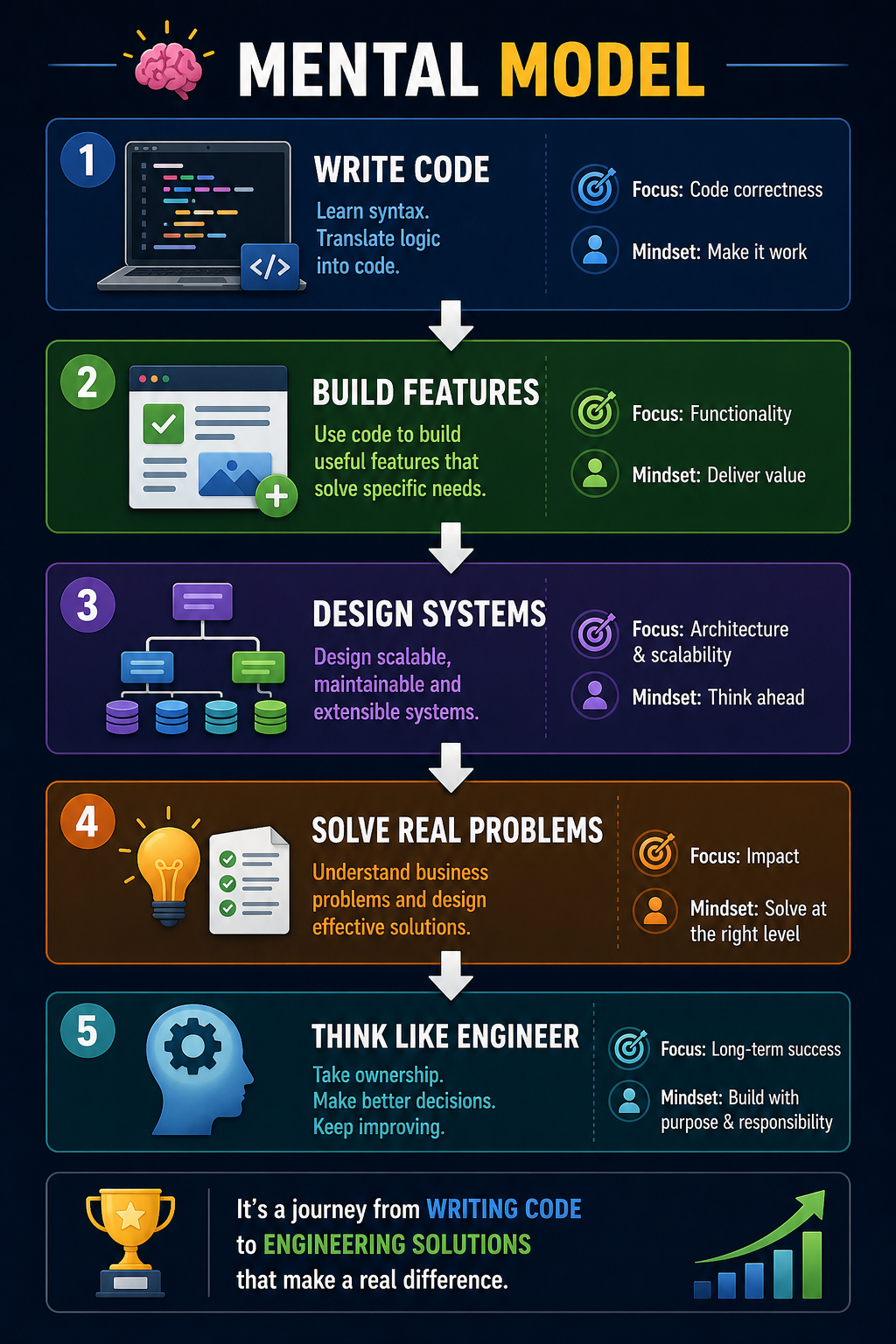
📖 Programmer vs Software Engineer
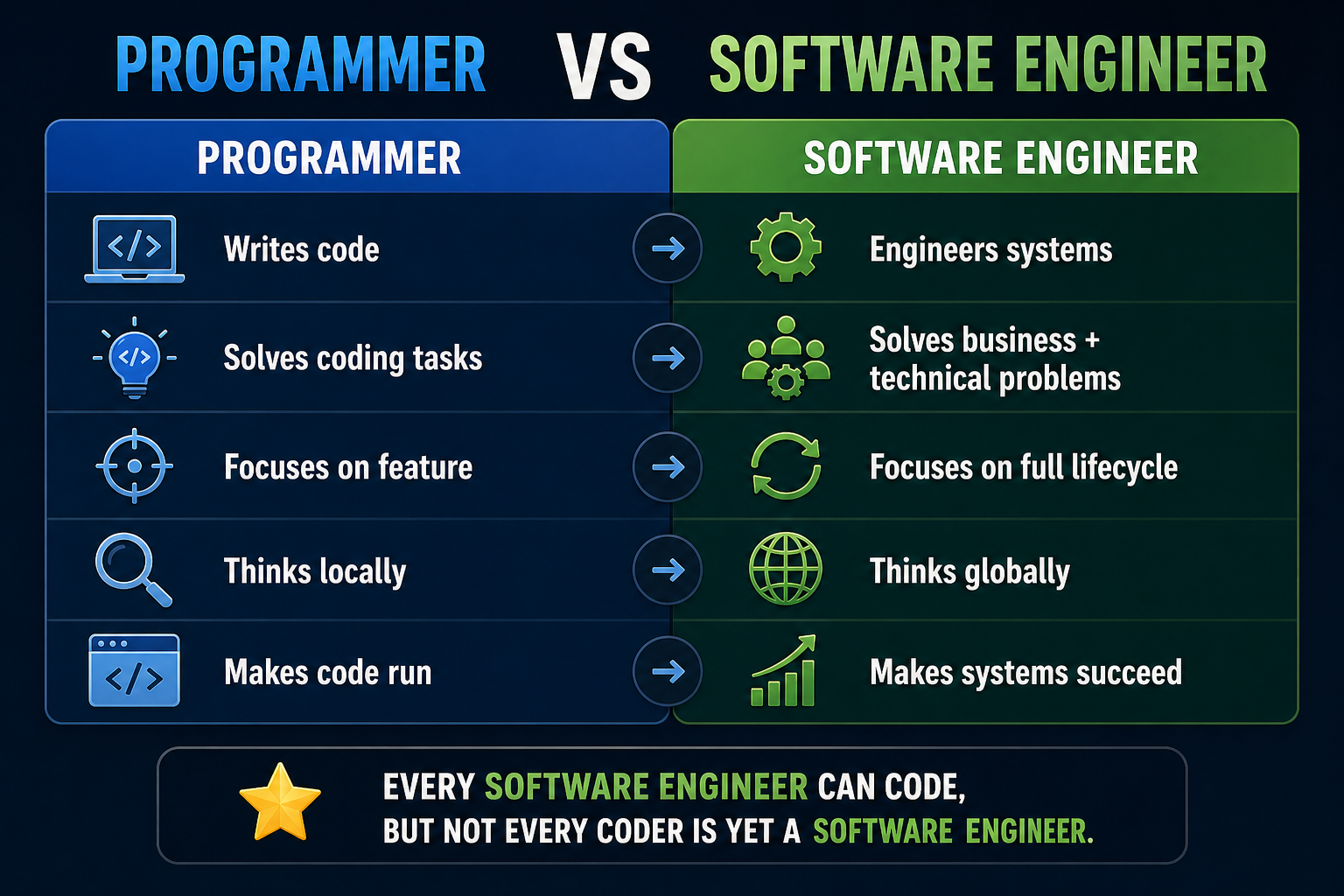
📌 Every Software Engineer can code, but not every coder is yet a Software Engineer.
📖 How the Journey Usually Starts
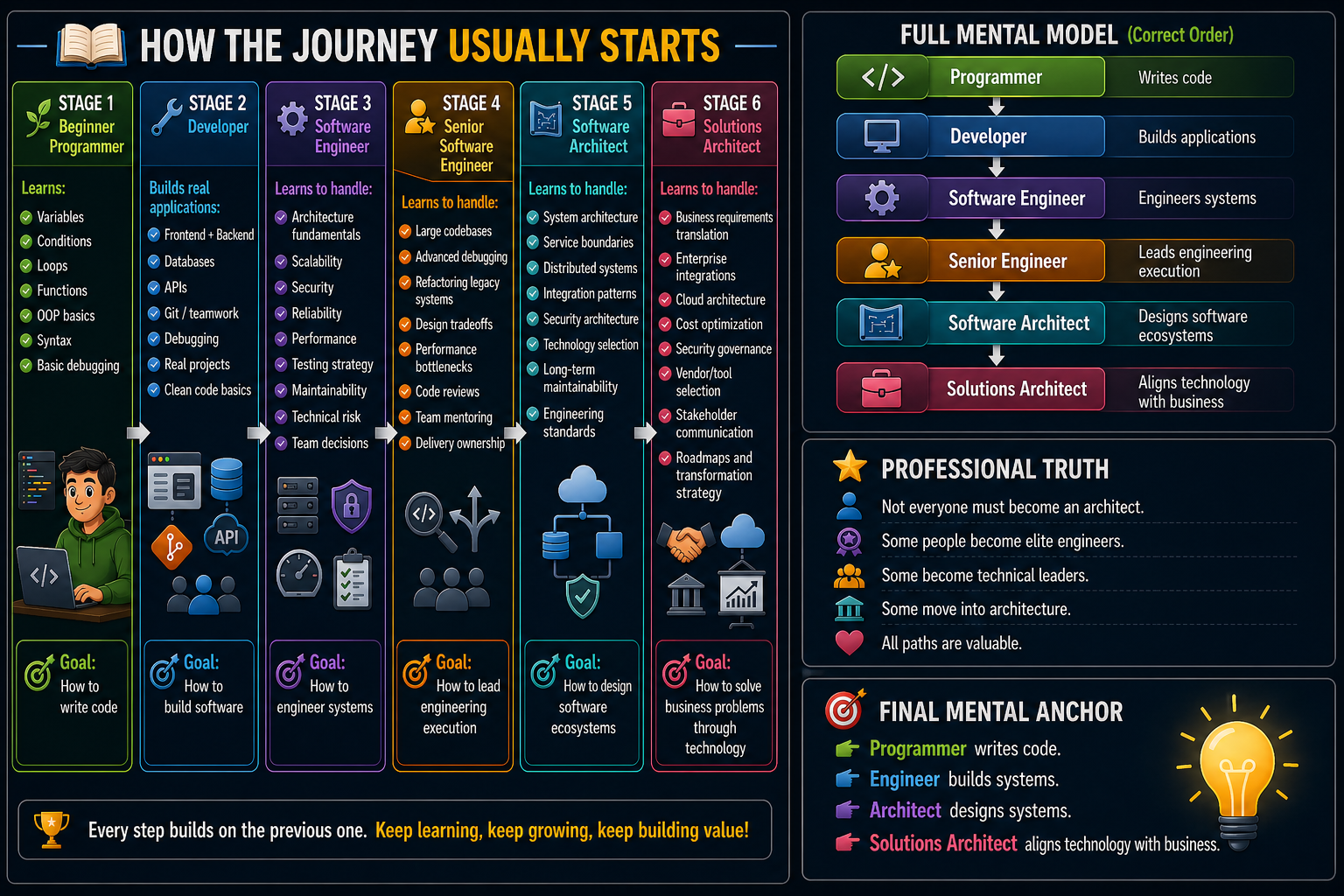
🧬 Stage 1 — Beginner Programmer
Learns:
🔹 Variables
🔹 Conditions
🔹 Loops
🔹 Functions
🔹 OOP basics
🔹 Syntax
🔹 Basic debugging
Goal:
How to write code
🧬 Stage 2 — Developer
Builds real applications:
🔹 Frontend + Backend
🔹 Databases
🔹 APIs
🔹 Git / teamwork
🔹 Debugging
🔹 Real projects
🔹 Clean code basics
Goal:
How to build software
🧬 Stage 3 — Software Engineer
Now mindset upgrades.
Learns to handle:
🔹 Architecture fundamentals
🔹 Scalability
🔹 Security
🔹 Reliability
🔹 Performance
🔹 Testing strategy
🔹 Maintainability
🔹 Technical risk
🔹 Team decisions
Goal:
How to engineer systems
🧬 Stage 4 — Senior Software Engineer
Now experience becomes judgment.
Leads complex delivery and mentors others.
Learns to handle:
🔹 Large codebases
🔹 Advanced debugging
🔹 Refactoring legacy systems
🔹 Design tradeoffs
🔹 Performance bottlenecks
🔹 Code reviews
🔹 Team mentoring
🔹 Delivery ownership
Goal:
How to lead engineering execution
🧬 Stage 5 — Software Architect
Now focus shifts from features to system blueprint.
Designs how major software systems should be built.
Learns to handle:
🔹 System architecture
🔹 Service boundaries
🔹 Distributed systems
🔹 Integration patterns
🔹 Security architecture
🔹 Technology selection
🔹 Long-term maintainability
🔹 Engineering standards
Goal:
How to design software ecosystems
🧬 Stage 6 — Solutions Architect
Now focus becomes business + technology alignment.
Designs complete solutions across multiple systems, teams, and platforms.
Learns to handle:
🔹 Business requirements translation
🔹 Enterprise integrations
🔹 Cloud architecture
🔹 Cost optimization
🔹 Security governance
🔹 Vendor/tool selection
🔹 Stakeholder communication
🔹 Roadmaps and transformation strategy
Goal:
How to solve business problems through technology
🧠 Full Mental Model
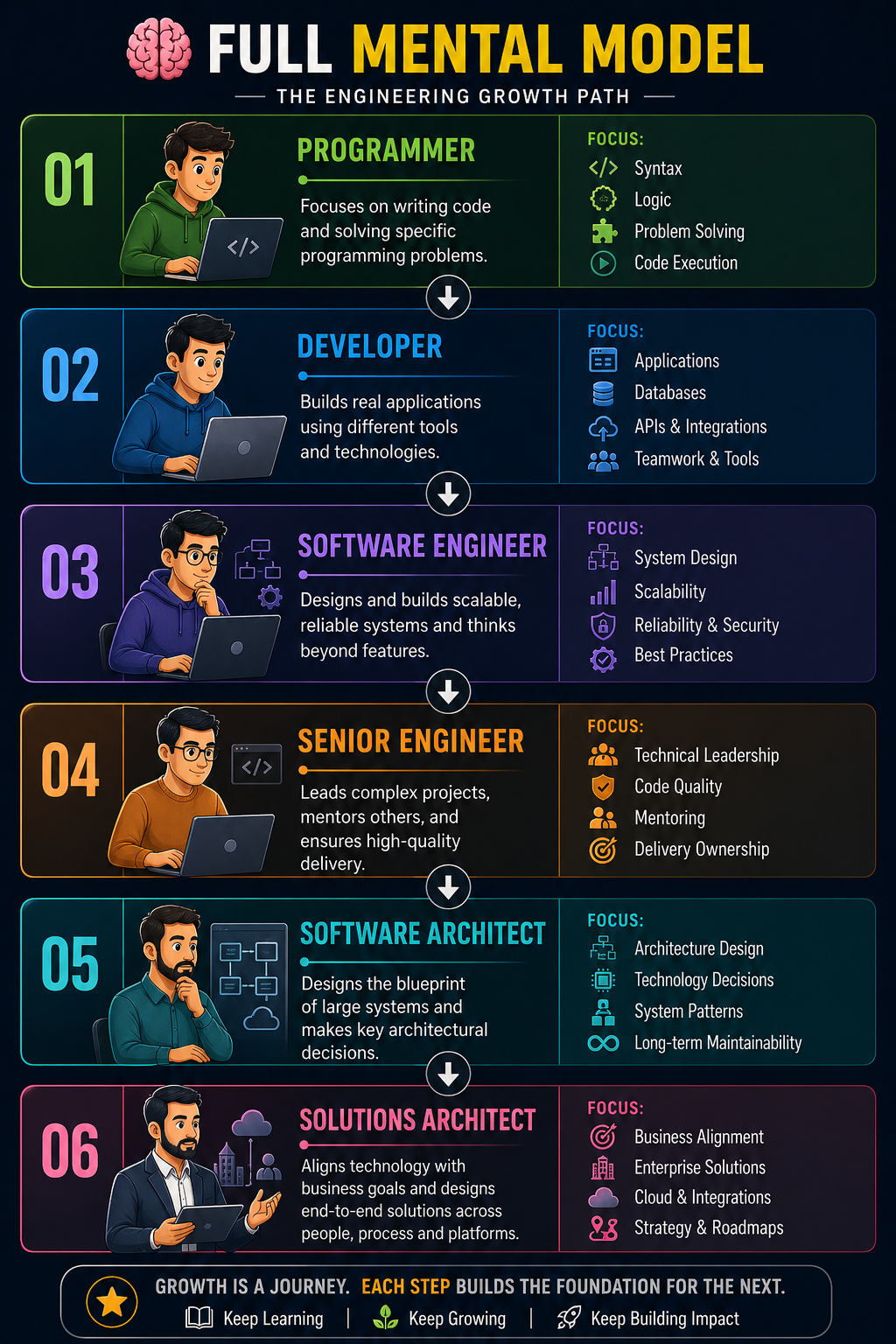
Programmer
   ↓
Developer
   ↓
Software Engineer
   ↓
Senior Engineer
   ↓
Software Architect
   ↓
Solutions Architect
💼 Professional Truth
🔹Not everyone must become an architect.
🔹Some people become elite engineers.
🔹Some become technical leaders.
🔹Some move into architecture.
🔹All paths are valuable.
🎯 Final Mental Anchor
👉 Programmer writes code.
👉 Engineer builds systems.
👉 Architect designs systems.
👉 Solutions Architect aligns technology with business.
📖 Real Example
A Programmer Asks:
How do I build login page?
A Software Engineer Asks:
🔹 How are passwords stored?
🔹 What if one million users log in?
🔹 What if DB server fails?
🔹 How do we prevent attacks?
🔹 How do we monitor abuse?
🔹 How will this scale later?
🔹 And Much more...
📌 That difference is mindset.
📖 What Makes Someone a Real Engineer?
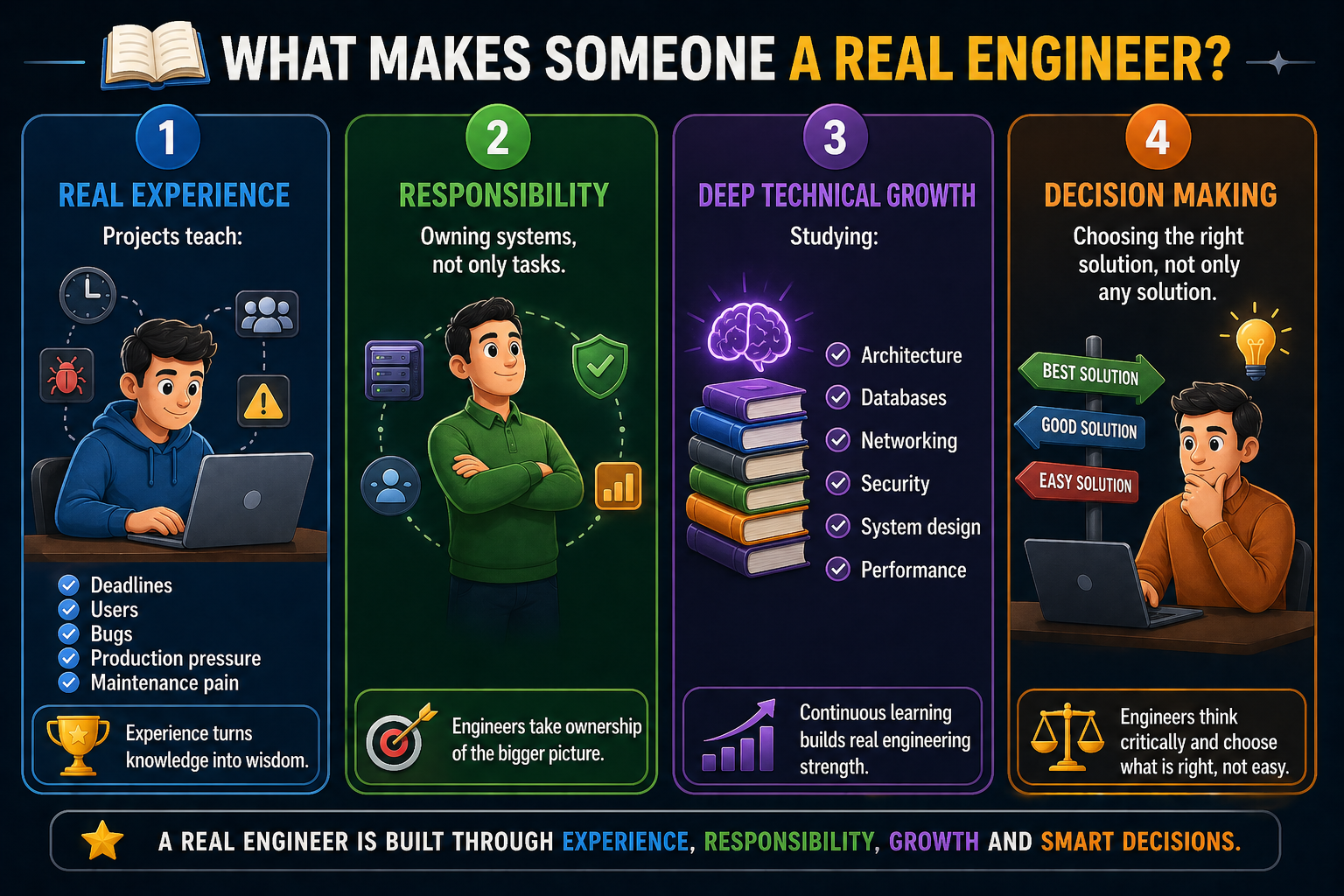
1️⃣ Real Experience
Projects teach:
🔹 Deadlines
🔹 Users
🔹 Bugs
🔹 Production pressure
🔹 Maintenance pain
2️⃣ Responsibility
Owning systems, not only tasks.
3️⃣ Deep Technical Growth
Studying:
🔹 Architecture
🔹 Databases
🔹 Networking
🔹 Security
🔹 System design
🔹 Performance
4️⃣ Decision Making
Choosing the right solution, not only any solution.
📖 Why Fresh Graduates Are Usually Not Full Engineers Yet
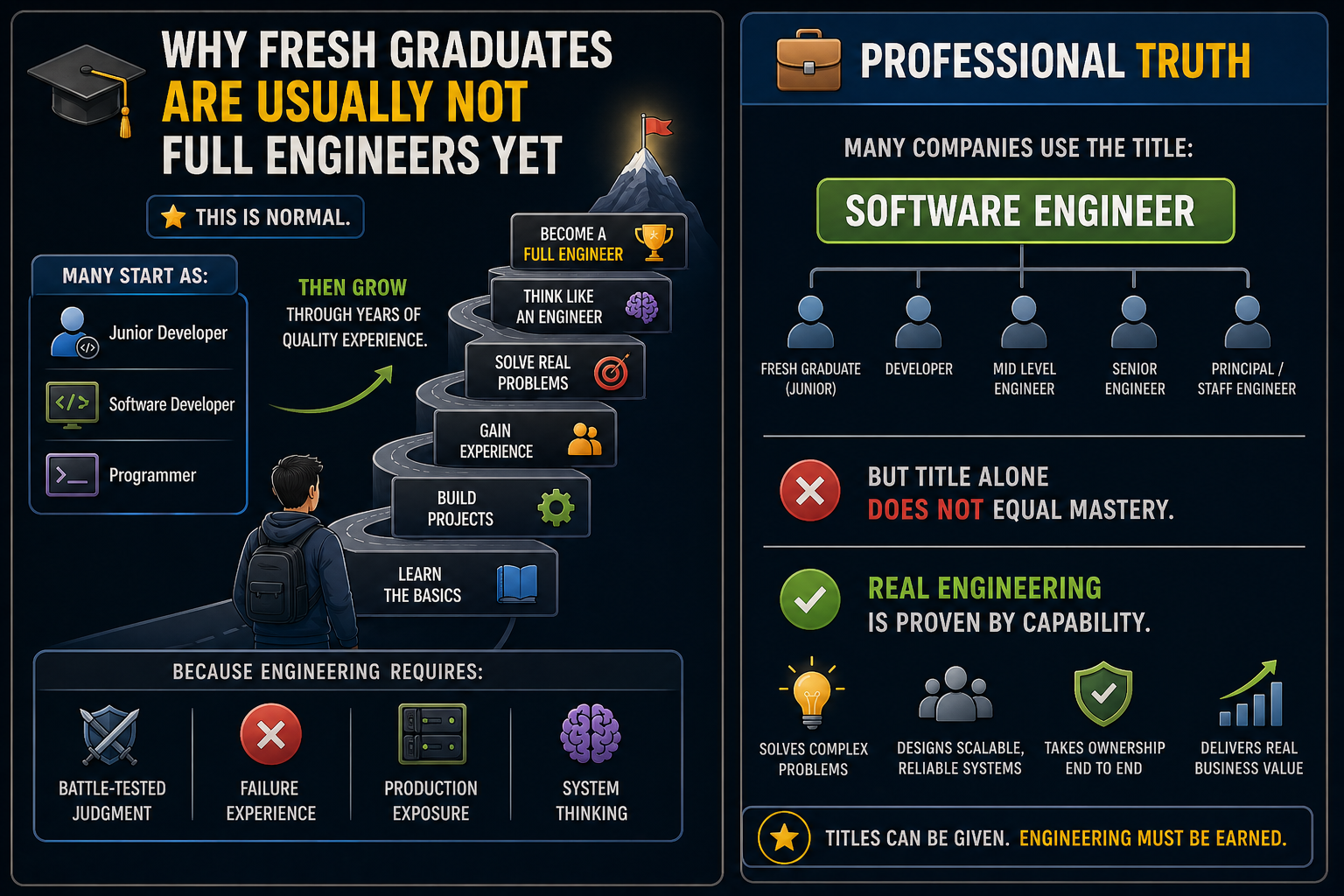
This is normal.
Many start as:
✔ Junior Developer
✔ Software Developer
✔ Programmer
Then grow through years of quality experience.
Because engineering requires:
✔ battle-tested judgment
✔ failure experience
✔ production exposure
✔ system thinking
💼 Professional Truth
Many companies use the title:
Software Engineer
for many levels.
But title alone does not equal mastery.
Real engineering is proven by capability.
📖 Where Software Engineers Work
🔹 Software companies
🔹 Banks
🔹 Hospitals
🔹 Telecom
🔹 Startups
🔹 Government
🔹 Consulting
🔹 Their own businesses
📖 Why This Career Is Powerful
✔ Global demand
✔ Strong salaries
✔ Remote opportunities
✔ Ability to build products
✔ High growth ceiling
✔ Constant learning
⚠️ Common Mistakes Students Make
❌ Mistake 1 — Learning Randomly Without Roadmap
Many students study disconnected topics with no sequence.
Example:
Today Docker
Tomorrow React
Next day Cybersecurity
Then Machine Learning
Without structure:
🔹 progress becomes chaotic
🔹 gaps grow silently
🔹 motivation drops
🔹 confidence becomes false
📌 Strong growth usually follows roadmap + progression.
❌ Mistake 2 — Ignoring Foundations
Learning surface tools without core foundations creates weak professionals.
Examples:
🔹 Skipping the first chapters of books where core principles are explained
🔹 Learning HTML without understanding how browsers render pages
🔹 Learning CSS without understanding layout flow and box model
🔹 Learning JavaScript without understanding scope, memory, and events
🔹 Learning EF Core without understanding databases and SQL
🔹 Learning APIs without understanding HTTP
🔹 Learning cloud tools without understanding networking
📌 Many learners chase advanced topics and skip the layers everything depends on.
📌 Tools change. Foundations stay.
👉 Strong engineers build on fundamentals, not shortcuts.
❌ Mistake 3 — Learning Advanced Topics Before Mastering Early Topics
Timing matters in learning.
Many students jump into advanced subjects before they are ready.
Examples:
🔹 Studying Design Patterns before building simple projects
🔹 Learning Microservices before mastering one clean monolithic app
🔹 Learning System Design before understanding databases and APIs
🔹 Studying advanced algorithms while weak in loops, functions, and OOP
🔹 Learning cloud architecture before understanding deployment basics
🔹 Learning AI frameworks before mastering programming fundamentals
📌 Advanced topics become confusing when earlier layers are weak.
Weak foundation
   ↓
Advanced topic added
   ↓
Confusion + fake confidence
📌 The right topic at the wrong time can slow progress.
👉 Sequence matters.
👉 Strong engineers respect learning order.
❌ Mistake 4 — Jumping to Frameworks Too Early
Frameworks are tools.
Fundamentals come first.
Examples:
🔹 Learning React before JavaScript basics
🔹 Learning EF Core before SQL and databases
🔹 Learning ASP.NET before HTTP understanding
🔹 Learning cloud platforms before networking basics
📌 Framework knowledge without foundations collapses under pressure.
❌ Mistake 5 — Chasing Syntax Only
Syntax alone does not create engineers.
Knowing keywords, commands, and language features is useful...
But without:
🔹 problem solving
🔹 design thinking
🔹 debugging
🔹 architecture thinking
You know words, but cannot build systems.
❌ Mistake 6 — Copy-Paste Learning / Wrong AI Learning
Copying code does not build engineering judgment.
Using AI only to generate answers without thinking creates fake progress.
Examples:
🔹 Copying projects line by line without understanding
🔹 Asking AI for full solutions every time
🔹 Memorizing outputs instead of reasoning
🔹 Depending on tools to debug everything
📌 AI should accelerate learning, not replace thinking.
👉 Use AI as assistant, not as brain.
❌ Mistake 7 — Avoiding Real Projects
Projects build judgment.
Courses teach concepts.
Projects teach reality.
Real projects expose you to:
🔹 messy requirements
🔹 bugs
🔹 deadlines
🔹 user behavior
🔹 design tradeoffs
📌 Without projects, confidence is often imaginary.
❌ Mistake 8 — Ignoring Debugging
Debugging is where real understanding appears.
When systems fail, debugging reveals:
🔹 how code really executes
🔹 hidden assumptions
🔹 performance issues
🔹 logic mistakes
📌 Students who avoid debugging stay shallow.
❌ Mistake 9 — Ignoring Databases
You cannot become strong in backend while weak in databases.
Weak DB skills create:
🔹 slow queries
🔹 bad schema design
🔹 broken relationships
🔹 poor scalability
🔹 weak reporting systems
📌 Weak DB skills = weak backend engineer.
❌ Mistake 10 — Quitting Too Early When It Gets Hard
Difficulty is normal.
Confusion often means growth is happening.
Students quit exactly when real learning begins:
🔹 debugging pain
🔹 architecture confusion
🔹 algorithm struggle
🔹 database complexity
📌 Friction is part of mastery.
❌ Mistake 11 — Thinking Years Alone Are Enough
Quality of experience matters more than time.
Someone with 2 years of intense real learning may outperform someone with 8 passive years.
Years only count when combined with:
🔹 challenge
🔹 reflection
🔹 responsibility
🔹 growth mindset
❌ Mistake 12 — Learning Without Building Communication Skills
Many technical students ignore communication.
But real engineers must explain:
🔹 problems
🔹 solutions
🔹 tradeoffs
🔹 risks
🔹 timelines
📌 Strong communication multiplies technical value.
❌ Mistake 13 — Always Choosing Easy Comfort Topics
Some students repeatedly study only topics they already enjoy.
They avoid:
🔹 databases
🔹 algorithms
🔹 debugging
🔹 architecture
🔹 deployment
📌 Growth often lives in uncomfortable topics.
🧠 Final Mental Anchor
👉 Most students fail not because they lack intelligence...
👉 They fail because they learn in the wrong order, the wrong way, or quit too early.
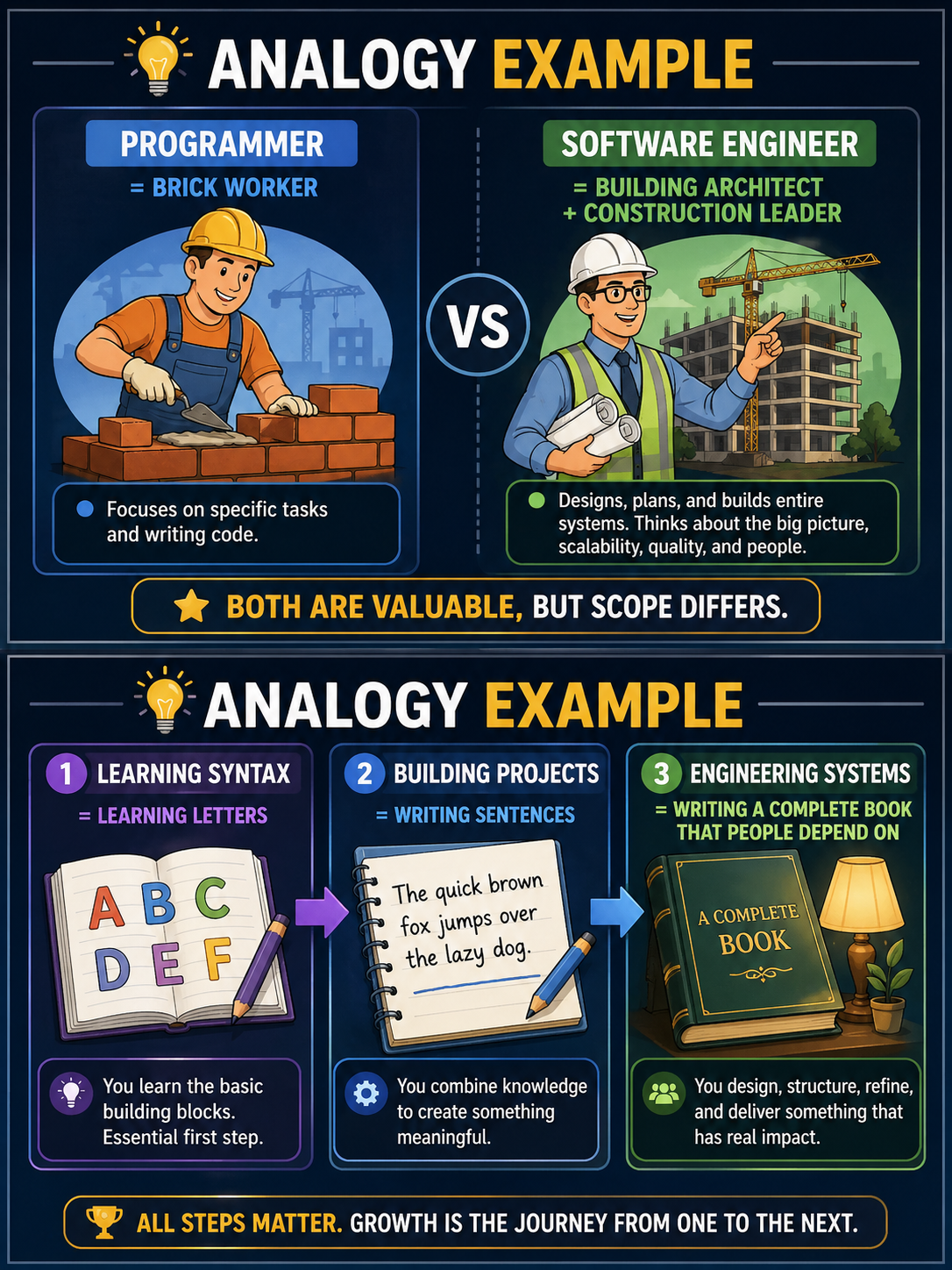
💡 Analogy Example
Programmer
= Brick worker

Software Engineer
= Building architect + construction leader
Both valuable, but scope differs.
💡 Analogy Example
Learning syntax
= learning letters


Building projects
= writing sentences


Engineering systems
= writing a complete book that people depend on
🧐 Activity
Who is closer to Software Engineer?
Person A
🔹 Knows syntax well
🔹 Builds calculators
🔹 Panics in large systems
Person B
🔹 Designs systems
🔹 Improves performance
🔹 Understands databases
🔹 Handles incidents
🔹 Leads technical decisions
💡 Activity Solution
👉 Person B is closer, because engineering is about system responsibility.
🧠 Mental Anchor (Lock This 🔒)
👉 Programming writes code.
👉 Engineering builds systems that survive reality.
🔗 Interconnection
Now you understand:
✔ difference between coder and engineer
✔ why mindset matters
✔ why experience matters
✔ why system thinking is critical
🏁 Conclusion
A Software Engineer is not defined by title.
They are defined by the ability to build systems that:
✔ Work
✔ Scale
✔ Stay secure
✔ Evolve over time
📌 Programming is the start of the road... engineering is the higher level. 🚀
65 comments